
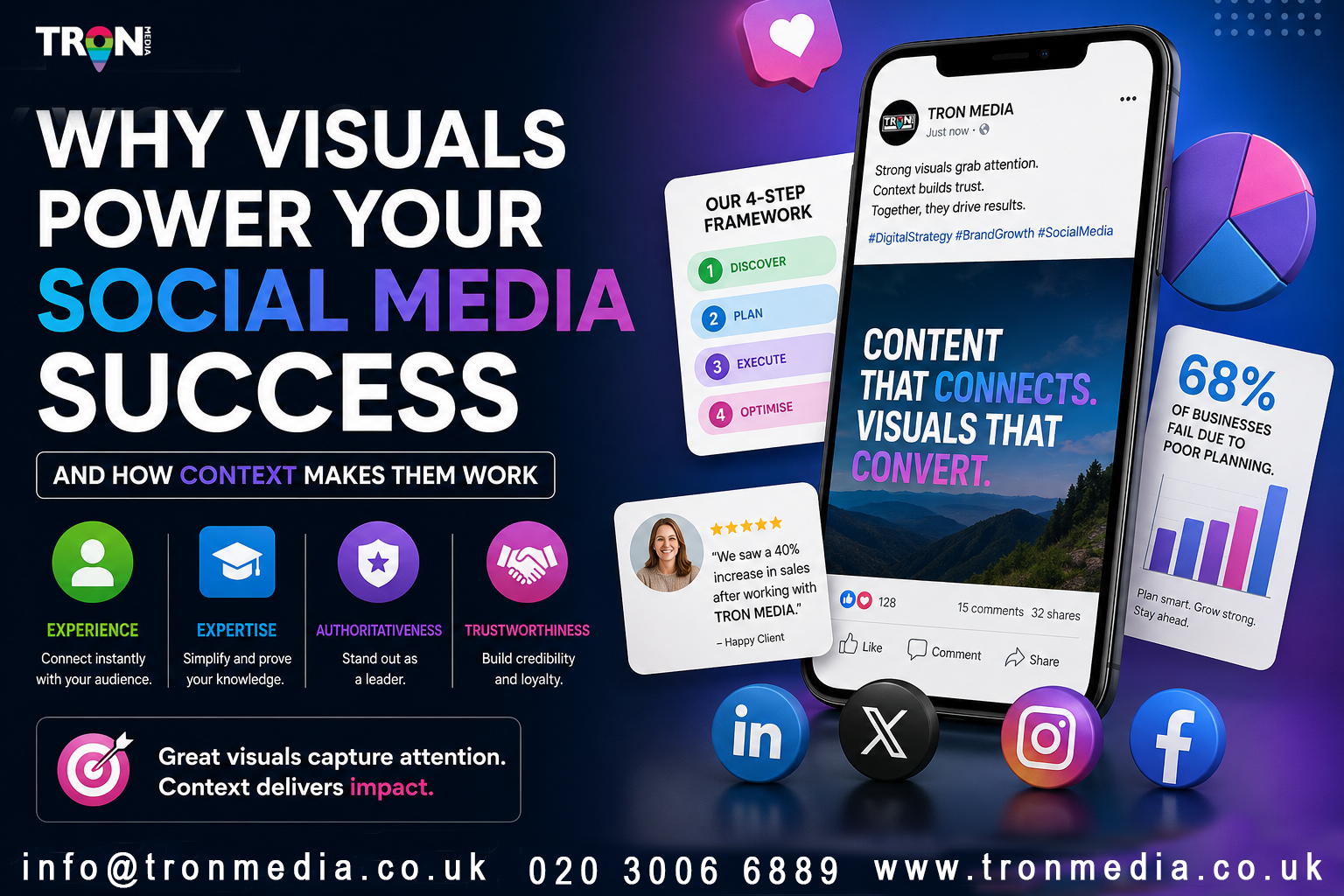
Why Visuals Power Your Social Media Success And How Context Makes Them Work
Let’s talk about digital space. Your social media posts have less than 2 seconds to grab attention. Text alone rarely cuts through the noise, but a strong, well-chosen image stops the scroll, communicates instantly, and invites people to engage. However, great visuals only work when paired with the right context. Together, they build authority, trust, and clarity, exactly what drives long-term growth.
This article breaks down why images are essential, which ones you should use, and most importantly, why adding clear context turns a nice picture into a high-performing, credible asset. It follows E-E-A-T principles, including Experience, Expertise, Authoritativeness, and Trustworthiness to ensure your content stands out as reliable and valuable.
Why Images Are Non-Negotiable: Built on E-E-A-T
1. Experience: Connect instantly with your audience
Humans process visuals 60,000 times faster than text, and 90% of what we absorb is visual. A relevant image creates an immediate emotional or practical connection. It shows you understand what your audience cares about, what problems they face, or what goals they want to reach. This demonstrates experience. You know your audience, their needs, and how to speak to them.
For example, if you share advice about remote work productivity, a photo of a well-organised home office feels familiar and relatable. It proves you understand the scenario, instead of just talking about it.
2. Expertise: Simplify and prove your knowledge
Complex ideas, data, or processes are hard to explain in words alone. Images, especially infographics, charts, or step-by-step visuals, break down difficult concepts into clear, digestible formats. When you visualise facts, frameworks, or results, you show you know your subject deeply. You are not just sharing opinions; you are demonstrating expertise by making complex knowledge easy to access and understand.
3. Authoritativeness: Stand out as a leader
High-quality, consistent, and purposeful visuals signal professionalism and thought leadership. When you use original, well-designed imagery instead of generic stock photos, you show you invest in your brand and your message. Over time, people recognise your style, trust your content, and see you as a reliable source. That is authoritativeness. Algorithms also reward this. Posts with strong visuals get 2x more engagement on LinkedIn, 150% more retweets on X, and 2.3x more likes on Facebook, expanding your reach and influence.
4. Trustworthiness: Build credibility and loyalty
75% of consumers say visual quality directly shapes how credible they find a business or brand. Blurry, irrelevant, or overused images make you look careless or untrustworthy. Clear, authentic visuals, especially photos of your team, your work, or real results, prove you are real, transparent, and honest. This builds trustworthiness, the foundation of every strong relationship with your audience.
Which Images Should You Use? And How Context Elevates Them
Not all visuals deliver value. Below are the best types to use, plus why adding context is the difference between a pretty picture and effective content.
1. Original Photography
Best for: Brand storytelling, team culture, products and services, behind-the-scenes, client results
What it is: Real photos you take, such as your workspace, your team at work, your product in use, or screenshots of results you have delivered.
Why context matters: A photo of your team means little on its own. But when you add context like “Our team is working through a new strategy to help clients cut costs by 20%”,, it transforms the image. It shows purpose, highlights your value, and proves you deliver results. Context turns a snapshot into proof of your experience and expertise.
Best practice: High resolution, natural lighting, authentic moments. Always explain what the image shows and why it matters to your audience.
2. Custom Branded Graphics
Best for: Tips, quotes, key takeaways, announcements, educational points
What it is: Designed visuals using your brand colours, fonts, and logo, including simple cards with short text, icons, or key messages.
Why context matters: A graphic that says “Consistency is key” is generic. Add context such as “Consistency in posting builds 3x more brand recognition. Here is how we help clients stay on track”, and it becomes actionable, authoritative advice. Context links the visual to your expertise and gives the audience a reason to care.
Best practice: Keep text short, follow your brand style. Always tie the graphic to a specific lesson, insight, or update.
3. Infographics & Data Visualisations
Best for: Statistics, research findings, how-to guides, industry comparisons, frameworks
What it is: Visual breakdowns of data, processes, or knowledge, including charts, diagrams, or step-by-step visuals.
Why context matters: Numbers or diagrams alone are confusing. Context explains what the data means, why it matters right now, and how people can use it. For example, instead of just a chart, add “This data shows 68% of businesses fail due to poor planning. Here is our proven framework to avoid that”. This positions you as an expert who not only has data but also understands and applies it.
Best practice: Clear layout, logical flow, simple language. Always interpret the data or concept for your audience.
4. User-Generated Content (UGC)
Best for: Social proof, testimonials, community building
What it is: Photos, reviews, or content shared by your clients, customers, or followers.
Why context matters: A customer photo means nothing without explanation. Add “This client achieved a 40% sales increase after working with us. Here is their story”, and it becomes powerful trust-building content. Context turns a random image into proof of real results, boosting your trustworthiness more than any branded content can.
Best practice: Always ask permission and credit the creator. Explain exactly what the content shows and what it means for others.
5. Illustrations & Diagrams
Best for: Explaining concepts, simplifying processes, and abstract ideas
What it is: Custom drawings or visuals used when photography does not fit or when you need to make something easier to understand.
Why context matters: An illustration of a process is unclear on its own. Context walks people through it, such as “This diagram shows our 4-step method to streamline operations. Here is how each step works”. It turns a drawing into educational content that showcases your expertise.
Best practice: Keep designs simple and aligned with your brand. Always describe or narrate what the visual represents.
What to Avoid
- Low-resolution, blurry, or pixelated images damage trust and authority.
- Generic, overused stock photos which feel impersonal and show a lack of experience.
- Visuals with no connection to your message confuse your audience and weaken your point.
- Too much text on images, which is hard to read on mobile and makes the content look cluttered and unprofessional.
- Inconsistent style, which makes your brand feel unorganised and less authoritative.
Why Context Is The Secret Weapon
Images capture attention. Context gives them meaning and value. Here is exactly what context does for your visuals.
- Adds clarity. It removes confusion, so your audience understands exactly what they are seeing and why it matters.
- Reinforces E-E-A-T. It turns a visual into proof of your experience, expertise, authority, and trustworthiness.
- Drives action. It tells people what to think, feel, or do next, whether that is learning more, trusting you, or working with you.
- Builds memory. People remember 65% of information when paired with a relevant image plus clear context, compared to only 10% from text alone.
Without context, an image is just decoration. With context, it becomes a powerful part of your brand story and your strategy.
Frequently Asked Questions
Q1: Do I need professional equipment to take good social media images?
No, you do not need expensive cameras or gear. Modern smartphones take high-quality photos that work perfectly. What matters most is good lighting, clear focus, clean composition, and authentic content. The most important thing is that the image is relevant and paired with clear context to show your expertise and value.
Q2: Can I use free stock photos for my posts?
Yes you can, but use them carefully and sparingly. Generic stock photos are overused and often feel impersonal. If you use them, always edit them to match your brand colours or style, and add very strong, specific context to make them unique and meaningful. Original photos and custom graphics are always better for building authority and trust.
Q3: How often should I change my visual style?
Keep your core style consistent long term. This means using the same colour palette, fonts, and overall look every time. You can make small updates or seasonal changes, but never change your style completely or randomly. Consistency helps people recognise your brand instantly and builds authority over time.
Q4: How much text should I put on an image?
Keep text to a minimum. Use only 3 to 5 words or a very short phrase. Long paragraphs or too many words make images hard to read on mobile screens and look cluttered. Put all the details, explanations, and context in your caption or post text instead.
Q5: Does image size or format matter across different platforms?
Yes it does. Each platform has ideal dimensions. For example, LinkedIn works best with 1200 x 628px, Instagram with 1080 x 1080px or 1080 x 1350px, and Facebook with 1200 x 630px. Always resize your visuals to fit the platform you are posting to. If images are cropped or distorted, they look unprofessional and hurt your credibility.
Q6: How do I add the right context to every image?
Ask yourself three questions before posting. What does this image show? Why is this important to my audience? What do I want people to learn or do? Answer these clearly in your caption or post text. This ensures every visual proves your experience, expertise, authority, and trustworthiness.
Q7: Can I reuse the same image multiple times?
Yes you can, but always change the context and message each time. Use the same visual to explain a different point, share a new insight, or highlight a different benefit. This saves time while keeping your content fresh and valuable. Never post the same image with the same text repeatedly.
Final Thoughts
Great social media content is not just about pretty pictures. It is about using visuals strategically, aligned with E-E-A-T, and supported by clear, meaningful context. Every image you share should have a purpose, a connection to your message, and an explanation that shows your audience why it matters to them.
When you do this consistently, you do not just get more likes or shares. You build a brand that is seen as experienced, expert, authoritative, and trustworthy. That is what turns casual followers into loyal clients and long-term partners.
Start today. Review your last 10 posts and check if your visuals are high-quality and relevant, and if you have added clear context to explain their value. That small change will make a huge difference to your results.
Want to know more?
Contact us here at Tron Media and find out how we can help you.